It is no surprise that coastal communities are particularly vulnerable to the multiple impacts of climate change. Current climate forecasts are predicting an increase at a rate of 0.2C per decade, and although global governments are implementing ways of limiting rising temperatures, it is inevitable that global warming will rise by 1.5C before 2055. This phenomenon will cause global sea levels to rise at an even quicker rate, along with the increasing prevalence and pressure of storms. These extremities were particularly evident last summer, with two months’ worth of rain falling in a day in parts of the UK.
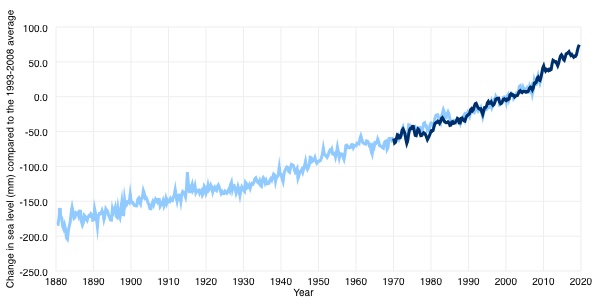
Fig.1 – A graph of global sea level rise since records began in 1880, showing that global sea level has risen by 200-230mm, with most of the rise commencing in the last 30 years. Source = NOAA Climate.gov
Coastal areas around the UK are particularly vulnerable to these extreme impacts of climate change. With the factors of global sea level rise and wave energy combining, this is will lead to increasing rates of cliff erosionand storm surges. In some circumstances, low pressure build-up can cause local sea level rise and wave erosion at the base of a cliff will eventually remove the foundation for the top section, hence creating instability in the cliff, and in due course, cliff collapse and landslides. Ultimately, this unequivocal phenomenon has brought about many physical, socio-economic and political impacts upon coastal communities, including damage to defence barriers and destruction of coastal ecosystems.
Each coastal area around the UK is affected differently by the scale and impacts of climate change. Communities which are most vulnerable to climate change are those relying on the coast for communications, social connections, residency and economic activity. Typically, residents at the coast are of an ageing population, thus, socio-economic issues such as low employment skills and summer seasonality of work factor into levels of vulnerability. One such place in the UK which has experienced significant cliff erosion is at Aldbrough, North Yorkshire. Here, the cliffs are rapidly being eroded at an estimated rate of 1.5 metres per year, resulting in several buildings being lost to the sea and still many more at risk.
There are many environmental, social and economic impacts deriving from climate change at Aldbrough. One such environmental pressure is the risk of losing Sites of Special Scientific Interest (SSSI) due to rapid erosion of sand bars from the sea. In terms of economic impacts, Easington Gas Terminal stands just 25m from the cliff edge and if we lose this plant, then significant underground storage facilities will be lost. It is vital we protect this terminal, especially since the gas storage facilities are critical to Britain’s energy security and ultimately constituting to 70% of the UK’s gas storage capacity. Social pressures include the risk of losing seaside caravan parks. The cliff edge stands metres away from some caravans and with erosion rates gradually rising many jobs and recreational income will be inevitably lost.
How can we tackle this?
The coast is the focal point of significant social, economic and environmental activities. However, there is not much we can do to prevent cliff collapse since climate change and coastal erosion is also as much a natural phenomenon as it is anthropogenic. What we can do is help communities to adapt and recover from such events. Despite local council’s expressing that support and funding are constantly offered, locals have felt “abandoned” and one resident from Easington states: “We have been offered no help and I can’t see any forthcoming”. In conclusion, climate change is slowly destroying our coasts, and it is only exacerbated by anthropogenic processes. Action needs to be taken to protect them, even if the solutions are not long term, whether this is preparation for relocation or funding, these communities need our help.

Source = HullLive
 The World Through My Eyes